

Blanding’s Turtle
Emydoidea blandingii
Animals on display may vary.
Diet
Blanding’s Turtles are omnivores, feeding on a variety of foods including aquatic invertebrates, insects, small fish, amphibians, and aquatic vegetation.
Average lifespan
Blanding’s Turtles are among the longest-lived freshwater turtles, and individuals in the wild have been documented living more than 80 years.
Size
Adult Blanding’s Turtles typically have a shell length of 18 to 25 centimeters (7 to 10 inches).
Weight
They generally weigh between 1 to 2 kilograms (2.2 to 4.4 pounds).
About
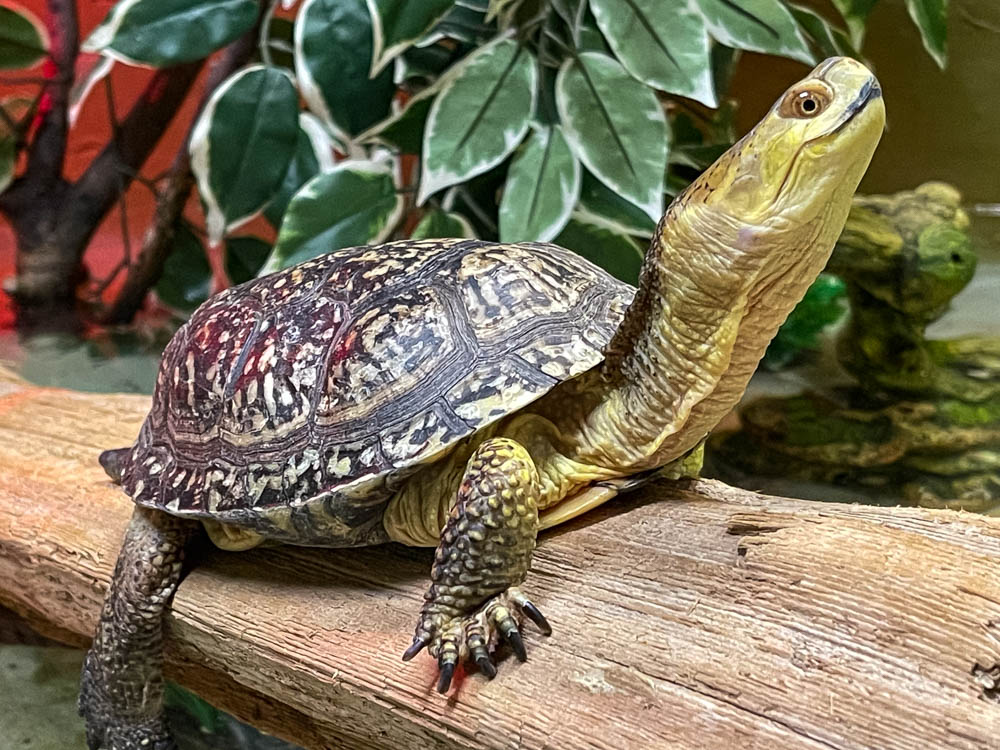
Blanding’s Turtles are semi-aquatic turtles native to North America, particularly found in the Great Lakes region and northeastern parts of the United States and Canada. They inhabit shallow wetlands, marshes, and ponds with abundant vegetation. Their high-domed shells are dark with yellow speckles, and they have bright yellow throats, which make them easily recognizable.
Size and behavior
Blanding’s Turtles are known for their semi-aquatic lifestyle, often basking on logs or rocks but also venturing onto land to forage or nest. They are relatively slow-moving and cautious, retreating to the water when disturbed. They are diurnal and most active during the day.
Diet and nutrition
As omnivores, Blanding’s Turtles consume both animal and plant matter. In the wild, they feed on aquatic invertebrates, small fish, tadpoles, and aquatic plants. Crayfish are a particular favourite, and much of their foraging happens in shallow, plant-filled water.
Temperate Forests & Ponds



Conservation status
Blanding’s Turtles are listed as Endangered or Threatened in many parts of their range due to habitat destruction, road mortality, and predation on their nests by mammals such as raccoons and foxes. Conservation efforts include habitat restoration, protection of nesting sites, and public education to reduce human impacts.
Fun fact
Blanding’s Turtles are known for their “perpetual smile” due to the shape of their mouths. This endearing feature, combined with their long lifespan, has made them a species of great interest in conservation biology. Additionally, they have a remarkable ability to survive in cold climates, remaining active under the ice in winter.
Common Name: Blanding’s Turtle
Also known as: Mr Pickles
Visit in person
Animals on display vary by location and may change from day to day.